No this is not a blogpost about the road or about my travels. Or
for that matter my travails, though I have been worried stiff,
sleepless and scared for close to twenty days now.
This blogpost is about my father who has recently been diagnosed
with a condition that makes it imperative for him to go for bypass
surgery. Which means that we have been doing the rounds of hospitals,
looking (or rather hoping) for non-invasive alternatives and
simultaneously doing the numerous things needed to get ready for
surgery.
All this while, my worries have dogged me and contributed to (yet
another) spell of silence here on the blog. In these intervening
twenty days I have read up widely on Angina, Bypass Surgeries, etc.
and also (naturally) on non-invasive cures / remedies such as
Enhanced External Counter Pulsation. All that I have learnt would
be of help to dad as advise meant to change his lifestyle for the
better, but (though I had fervently hoped for it) what he needs as
of now is a bypass. But then all this reading up and this increased
familiarity with the terms involved have helped the worries
are still there, if in a bit more subdued and benign form and will
keep dogging me till my father gets operated on, is back home and
through with recuperation and back on his feet, to be dad as usual.
Meanwhile, I will pray for the continued health of my father
and his blessedly friendly, solidly always there presence in my life.
Om Namaha Shivaya
Friday, November 18, 2011


Sunday, October 30, 2011
As grass dries under a winter sun
I am reading Whitman and I honestly don't know what to make
of him and his absolutely untrammeled, "as honest as homespun"
writing.
To be precise, I am reading "Song of Myself", a "long" poem that
defeats any attempts (not that I -- not that well read -- am trying)
to genrify or label; but is evidently a magnum opus of consciousness,
frankness and time.
Incidentally, this book has inspired (among others) other poetic
magnum opuses, other long poems like Relationship by Shri Jayanta
Mahapatra, which is yet another piece of work that defeats any
attempts to genrify or label.
But (like Song of Myself) just leaves you stunned.
Speaking of Song of Myself this is a poem that shouts out its
outdoorsiness, its location in the wide open spaces and the lap of
nature. And his ability to connect with the elements, an oracle like
ability to hear the epiphanies lost to more cultured and civilized
sensibilities.
Like when he sees and gives voice to a whole universe of soul and
meaning when he writes about grass. One wonders how much of this is
about the poet uncovering basic truths (that given time, mood and
similar approach you and I could too)and how much of this is about the
articulation of his own views. In a way he paints up a narrative in
which the canvas is both a landscape and a portrait at the same time.
There are some peculiarities (apart from a tone that could seem
intimately fraternal or mildly homosexual -- depending on how you view
it) that are strikingly idiosyncratic -- usage of epsilons (four dots
and not three as is the norm these days) and a treatment that blends
the grandiloquent and the pedestal-seeking in equal measure. But then,
this is Walt Whitman, and in all probability that profundity, that
uninhibited wealth of wordiness is what made him the trendsetter that
he is.
Incidentally, this poem was untitled and part of the book Leaves of Grass
(the very name indicative of the poet's amazing eye* as a naturalist)
and was self-published him when he was around 35. Fittingly enough, the
cover has a sketch of the poet, looking very rugged and outdoorsy and
very much part of an age that did not bother too much about sunscreen
(with a high SPF factor, mind) or hair dye.
Fittingly enough (from a reader's perspective) I write this as grass
dries all around me, turning golden brown by degrees -- from a rain-fed
green -- and the sun loses its burning intensity, turning evenings into
dapples of golden light.
The right time for indulging in profundity for drawing portraits and
landscapes.
* -- Do I mean "depth of field" ? Ah, well....
of him and his absolutely untrammeled, "as honest as homespun"
writing.
To be precise, I am reading "Song of Myself", a "long" poem that
defeats any attempts (not that I -- not that well read -- am trying)
to genrify or label; but is evidently a magnum opus of consciousness,
frankness and time.
Incidentally, this book has inspired (among others) other poetic
magnum opuses, other long poems like Relationship by Shri Jayanta
Mahapatra, which is yet another piece of work that defeats any
attempts to genrify or label.
But (like Song of Myself) just leaves you stunned.
Speaking of Song of Myself this is a poem that shouts out its
outdoorsiness, its location in the wide open spaces and the lap of
nature. And his ability to connect with the elements, an oracle like
ability to hear the epiphanies lost to more cultured and civilized
sensibilities.
Like when he sees and gives voice to a whole universe of soul and
meaning when he writes about grass. One wonders how much of this is
about the poet uncovering basic truths (that given time, mood and
similar approach you and I could too)and how much of this is about the
articulation of his own views. In a way he paints up a narrative in
which the canvas is both a landscape and a portrait at the same time.
There are some peculiarities (apart from a tone that could seem
intimately fraternal or mildly homosexual -- depending on how you view
it) that are strikingly idiosyncratic -- usage of epsilons (four dots
and not three as is the norm these days) and a treatment that blends
the grandiloquent and the pedestal-seeking in equal measure. But then,
this is Walt Whitman, and in all probability that profundity, that
uninhibited wealth of wordiness is what made him the trendsetter that
he is.
Incidentally, this poem was untitled and part of the book Leaves of Grass
(the very name indicative of the poet's amazing eye* as a naturalist)
and was self-published him when he was around 35. Fittingly enough, the
cover has a sketch of the poet, looking very rugged and outdoorsy and
very much part of an age that did not bother too much about sunscreen
(with a high SPF factor, mind) or hair dye.
Fittingly enough (from a reader's perspective) I write this as grass
dries all around me, turning golden brown by degrees -- from a rain-fed
green -- and the sun loses its burning intensity, turning evenings into
dapples of golden light.
The right time for indulging in profundity for drawing portraits and
landscapes.
* -- Do I mean "depth of field" ? Ah, well....
Saturday, October 22, 2011
Song of Myself (6)
A child said, What is the grass? fetching it to me with full hands;
How could I answer the child?....I do not know what it is any
more than he.
I guess it must be the flag of my disposition, out of hopeful green
stuff woven.
Or I guess it is the handkerchief of the Lord,
A scented gift and remembrancer designedly dropped,
Bearing the owner's name someway in the corners, that we may see
and remark, and say Whose?
Or I guess the grass is itself a child....the produced babe of the
vegetation.
Or I guess it is a uniform hieroglyphyic,
And it means, Sprouting alike in broad zones and narrow zones,
Growing among black folks as among white,
Kanuck, Tuckahoe, Congressman, Cuff, I give them the same, I
receive them the same.
And now it seems to me the beautiful uncut hair of grass.
Tenderly will I use you curling grass,
It may be you transpire from the breasts of young men,
It may be if I had known them I would have loved them;
It may be you are from old people and from women, and from
offspring taken soon out of their mothers' laps,
And here you are the mothers' laps.
This grass is very dark to be from the white heads of old mothers,
Darker than the colourless beards of old men,
Dark to come from under the faint red roofs of mouths.
O I perceive after all so many uttering tongues!
And I perceive they do not come from the roofs of mouths for
nothing.
I wish I could translate the hints about the dead young men and
women,
And the hints about old men and mothers, and the offspring taken
soon out of their laps.
What do you think has become of the young and old men?
And what do you think has become of the women and children?
They are alive and well somewhere;
The smallest sprout shows there is really no death,
And if ever there was it led forward life, and does not wait at the end
to arrest it,
And cease the moment life appeared.
All goes onward and outward....and nothing collapses,
And to die is different from what any one supposed, and luckier.
By Walt Whitman from Song of Myself
Blogger doesn't let me insert space breaks, my apologies!
How could I answer the child?....I do not know what it is any
more than he.
I guess it must be the flag of my disposition, out of hopeful green
stuff woven.
Or I guess it is the handkerchief of the Lord,
A scented gift and remembrancer designedly dropped,
Bearing the owner's name someway in the corners, that we may see
and remark, and say Whose?
Or I guess the grass is itself a child....the produced babe of the
vegetation.
Or I guess it is a uniform hieroglyphyic,
And it means, Sprouting alike in broad zones and narrow zones,
Growing among black folks as among white,
Kanuck, Tuckahoe, Congressman, Cuff, I give them the same, I
receive them the same.
And now it seems to me the beautiful uncut hair of grass.
Tenderly will I use you curling grass,
It may be you transpire from the breasts of young men,
It may be if I had known them I would have loved them;
It may be you are from old people and from women, and from
offspring taken soon out of their mothers' laps,
And here you are the mothers' laps.
This grass is very dark to be from the white heads of old mothers,
Darker than the colourless beards of old men,
Dark to come from under the faint red roofs of mouths.
O I perceive after all so many uttering tongues!
And I perceive they do not come from the roofs of mouths for
nothing.
I wish I could translate the hints about the dead young men and
women,
And the hints about old men and mothers, and the offspring taken
soon out of their laps.
What do you think has become of the young and old men?
And what do you think has become of the women and children?
They are alive and well somewhere;
The smallest sprout shows there is really no death,
And if ever there was it led forward life, and does not wait at the end
to arrest it,
And cease the moment life appeared.
All goes onward and outward....and nothing collapses,
And to die is different from what any one supposed, and luckier.
By Walt Whitman from Song of Myself
Blogger doesn't let me insert space breaks, my apologies!
Neighbourhood
On the narrow steps leading to our gate,
the pakoriwallah from Bihar is often found
kissing an anonymous woman at night.
Amazing act. My parents switch off the sitting-room
lights whenever this happens. The car beams show
them up -- one unbroken secret silhouette.
The steps invite other actions. The local fakir some-
times lies there, coloured like a ditch, and passers-by
might climb to have a better look at the orange trees.
But this is different. The soft-spoken pakoriwallah
smelling of his pakoris, his half hour island of
defiant passion on the steps of somebody's house,
while around him everyday: the brash freeloaders,
the kick in the groin, the familiar words of abuse
spoken in an unfamiliar language.
By Anjum Hasan, from Street on the Hill, Sahitya Akademi (2006)
the pakoriwallah from Bihar is often found
kissing an anonymous woman at night.
Amazing act. My parents switch off the sitting-room
lights whenever this happens. The car beams show
them up -- one unbroken secret silhouette.
The steps invite other actions. The local fakir some-
times lies there, coloured like a ditch, and passers-by
might climb to have a better look at the orange trees.
But this is different. The soft-spoken pakoriwallah
smelling of his pakoris, his half hour island of
defiant passion on the steps of somebody's house,
while around him everyday: the brash freeloaders,
the kick in the groin, the familiar words of abuse
spoken in an unfamiliar language.
By Anjum Hasan, from Street on the Hill, Sahitya Akademi (2006)
Friday, October 21, 2011
Delhi -- Vignettes of this and that
The Autorickshaws here in Hyderabad are bug like, bright yellow
and black and thanks to the cussedness and perspicacity of their
drivers -- when it comes to getting the most out of every
passenger (especially with no other dependable means of public
transport), downright infamous. In Delhi, they are a eco-friendly
green -- run as they do only on CNG -- and their drivers
are positively chatty, if in a so what "let's show this
tourist the ropes of the capital" way. And not exactly looking
at stringing you for a million bucks, either.
Must be the effect of working in the shadow of the metro, or
the fact that migrants and movers (most of the auto drivers are
from Bihar and U.P., the archetypal Bhhaiyas) aren't exactly
there in the same league with local hicks when it comes to driving
a hard bargain. Or, for all I know, considering the volumes of
Autorickshaw users in Delhi, they get enough bakras and fight shy
of tangling with a Ray Ban wearing south Indian looking fellow
speaking in unaccented Hindi.
#$#@&^
The Delhi Metro is surprisingly seductive and far more efficient
and user-friendly (with amazingly polite and courteous staff) than I
expected it to be. Cameras cannot be used on the platforms (I
did not know and was merrily clicking away in one of the entrance
tunnels, but all that an armed policeman -- security is tight but
more or less non-invasive -- did was to wave at me in a minor
reprimand, no tongue-lashing, no checking, etc.) but it would be
fun to do some slow shutter speed photography on one of those
"junction" platforms when the passengers are moving from one
train to another, or running up or down, indistinct motion blurs
of a city's constituents on the move.
Getting buffeted by the slipstreams of all the moving humanity
is of course part of being the city's.
Yes, I traveled quite a bit on the metro and would say that
its easy enough to use. Also, evidently it is okay to be confused
and unaware of which train you should catch to get to your
destination. A lot of passengers around me were in the same
predicament. But then, there are enough staff (and police) around
to point in the right direction, so one learns and catches yet
another metro train.
#$#@&^
Sadar Road -- which passed through what seems like a continuous
village of two and three storied, un-plastered brick houses ill
at ease with the cheek-by-jowl sprawl of being part of a
city -- was where my hotel was at. And since it was a budget
hotel (but surprisingly clean and comfortable) not that stand-out or
hat ke from the environs all
around, either.
All of which meant that I had the proverbial room with a
view -- of a two laned road (with one under repairs), vegetable and
fruit hawkers (most of them in the middle of that road, under the
shade of bright yellow and green polythenes) the "one old teak chair
and a mirror is all it takes to be a saloon" barber shops. So many
rickshaws and tongas too, itinerantly at work all through the
heat and dust, going and coming.
Then there were the Black Kites in the skies above; along with
swarms of pigeons flying in formation -- probably from one coop
to another. Surprisingly, I did not take any photographs, the
atmosphere of impersonal strangeness in the hotel room helped
along my procrastination and the angles I could mentally
compose did not seem wide and encompassing enough as that
of a narrative. And the heat and dust didn't help either.
#%$@&
I am artless, unsophisticated and very, very middle class. So
I have no compunctions about eating anywhere as long as the place
is clean and the food promises an adventure for the palate. My
lunch and dinner was right on Sadar Road in two hotels that were
more or less holes in the wall. The food was rustic, honest and
right in tune with the in-your-face character of Sadar Road
(okay, I know it leads to Paharganj which has a reputation for being
seedy, but I never ventured that side). Paranthas (and curd) for two
(A ate with me on the first day, after helping me move in and settle
down in the hotel) as brunch and then Paranthas for one as a late
lunch. The hotel was run by a Sikh who surprisingly welcomed us
with a very salesman like Namaste (totally A's doing and his
Delhiness, I said or did nothing much but pronounce Parantha
the right way). The other culinary adventure (again in Sadar Road)
was at another hole in the wall type of eatery where I had
Rajma Masala (surprisingly hot) that came with grated cheese and
Matar Paneer (served with a big blob of butter) and Rotis (small
and saucer sized and served right out of the Tandoor) at Rs. 2
each. Nice and filling and the bill wasn't even in three figures
which was a welcome salve to my middle class wallet.
And yes, I ate elsewhere too. Like near the metro stations. While
watching the rickshaws queue up in neat orderly rows. I ate food
that was as inexpensive as a rickshaw fare -- Chole Bhatureys and
Channa Kulchas -- and as simple and unpretentious.
BTW, no Delhi Belly to report.
and black and thanks to the cussedness and perspicacity of their
drivers -- when it comes to getting the most out of every
passenger (especially with no other dependable means of public
transport), downright infamous. In Delhi, they are a eco-friendly
green -- run as they do only on CNG -- and their drivers
are positively chatty, if in a so what "let's show this
tourist the ropes of the capital" way. And not exactly looking
at stringing you for a million bucks, either.
Must be the effect of working in the shadow of the metro, or
the fact that migrants and movers (most of the auto drivers are
from Bihar and U.P., the archetypal Bhhaiyas) aren't exactly
there in the same league with local hicks when it comes to driving
a hard bargain. Or, for all I know, considering the volumes of
Autorickshaw users in Delhi, they get enough bakras and fight shy
of tangling with a Ray Ban wearing south Indian looking fellow
speaking in unaccented Hindi.
#$#@&^
The Delhi Metro is surprisingly seductive and far more efficient
and user-friendly (with amazingly polite and courteous staff) than I
expected it to be. Cameras cannot be used on the platforms (I
did not know and was merrily clicking away in one of the entrance
tunnels, but all that an armed policeman -- security is tight but
more or less non-invasive -- did was to wave at me in a minor
reprimand, no tongue-lashing, no checking, etc.) but it would be
fun to do some slow shutter speed photography on one of those
"junction" platforms when the passengers are moving from one
train to another, or running up or down, indistinct motion blurs
of a city's constituents on the move.
Getting buffeted by the slipstreams of all the moving humanity
is of course part of being the city's.
Yes, I traveled quite a bit on the metro and would say that
its easy enough to use. Also, evidently it is okay to be confused
and unaware of which train you should catch to get to your
destination. A lot of passengers around me were in the same
predicament. But then, there are enough staff (and police) around
to point in the right direction, so one learns and catches yet
another metro train.
#$#@&^
Sadar Road -- which passed through what seems like a continuous
village of two and three storied, un-plastered brick houses ill
at ease with the cheek-by-jowl sprawl of being part of a
city -- was where my hotel was at. And since it was a budget
hotel (but surprisingly clean and comfortable) not that stand-out or
hat ke from the environs all
around, either.
All of which meant that I had the proverbial room with a
view -- of a two laned road (with one under repairs), vegetable and
fruit hawkers (most of them in the middle of that road, under the
shade of bright yellow and green polythenes) the "one old teak chair
and a mirror is all it takes to be a saloon" barber shops. So many
rickshaws and tongas too, itinerantly at work all through the
heat and dust, going and coming.
Then there were the Black Kites in the skies above; along with
swarms of pigeons flying in formation -- probably from one coop
to another. Surprisingly, I did not take any photographs, the
atmosphere of impersonal strangeness in the hotel room helped
along my procrastination and the angles I could mentally
compose did not seem wide and encompassing enough as that
of a narrative. And the heat and dust didn't help either.
#%$@&
I am artless, unsophisticated and very, very middle class. So
I have no compunctions about eating anywhere as long as the place
is clean and the food promises an adventure for the palate. My
lunch and dinner was right on Sadar Road in two hotels that were
more or less holes in the wall. The food was rustic, honest and
right in tune with the in-your-face character of Sadar Road
(okay, I know it leads to Paharganj which has a reputation for being
seedy, but I never ventured that side). Paranthas (and curd) for two
(A ate with me on the first day, after helping me move in and settle
down in the hotel) as brunch and then Paranthas for one as a late
lunch. The hotel was run by a Sikh who surprisingly welcomed us
with a very salesman like Namaste (totally A's doing and his
Delhiness, I said or did nothing much but pronounce Parantha
the right way). The other culinary adventure (again in Sadar Road)
was at another hole in the wall type of eatery where I had
Rajma Masala (surprisingly hot) that came with grated cheese and
Matar Paneer (served with a big blob of butter) and Rotis (small
and saucer sized and served right out of the Tandoor) at Rs. 2
each. Nice and filling and the bill wasn't even in three figures
which was a welcome salve to my middle class wallet.
And yes, I ate elsewhere too. Like near the metro stations. While
watching the rickshaws queue up in neat orderly rows. I ate food
that was as inexpensive as a rickshaw fare -- Chole Bhatureys and
Channa Kulchas -- and as simple and unpretentious.
BTW, no Delhi Belly to report.
Subscribe to:
Posts (Atom)
About Me
- Anand Vishwanadha
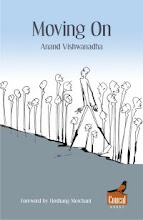
- Hello and welcome! I am someone who is passionate about poetry and motorcycling and I read and write a lot (writing, for me has been a calling, a release and a career). My debut collection of English poems, "Moving On" was published by Coucal Books in December 2009. It can be ordered here My second poetry collection, Ink Dries can be ordered here Leave a comment or do write to me at ahighwayman(at)gmail(dot)com.
Take A Look See
-
-
-
Meet Annie the author10 years ago
-
Poems online5 years ago
-
-
-
-
When to have THE TALK with the kids11 months ago
-
An Analysis of Trump9 years ago
-
-
-
Where journeys end8 months ago
-
-
-
-
-
Indian in Space: A phony Socialist trick14 years ago
-
Recipe – Easy Apple Halwa5 years ago


