My good friend and host at Bhubaneshwar, S is a poet / journalist and the editor and publisher of a Odiya "little magazine", Samakala. S also happens to be a voracious reader and someone with an eclectic taste, which meant that I had a lot to choose from when it came to doing some "quality" reading.
And I did read a book, as in finish it, in more or less one sitting, the way it ideally should be, mostly because the book was gripping (and not that thick) and partly because I wanted to finish it in one sitting. Somehow, in keeping with the atmosphere of S's place -- almost choc-a-bloc full with books, largely in Odiya, it was somehow apt that the book in question was It Rained All Night by Buddhadeva Bose originally a Bengali novel (with a lot of infamy, if I may so add -- banned when it was first published in the Bengali in 1967 on charges of obscenity) in a masterly translation by Clinton B Seely.
What a lovely story (honestly it doesn't seem worth all that infamy, even in the 1960s) and it is certainly not graphic or obscene (at least not in translation) and seems just right to be called a "quick read", though the language is not what Chetan Bhagat will ever be capable of.
Also, what an indicator of the excellence and talent that lies hidden away from mainline English readers in India!
Definitely worth a second read, maybe I will get it and do a bit more of a blogpost on it soon.
Here's a good take on it
I also read Arzee the Dwarf by Chandrahas Choudhury and it was a good read, with parts indicative of a good eye for detail (and the description of it) but somehow I did not find any high-points in the book; maybe I need to read it again.
******
There is this thing expected of me, whenever I go to Odisha. Yes, you guessed it right -- in case you know me or read this blog -- visits to Jagannath Puri and Lingaraja temples. I don't like a lot of things about going to temples -- the crowds, the lack of hygiene, the almost "not there" in terms of basic facilities for pilgrims and so on -- especially if the temples are famous / holy / revered (all three aren't exactly the word I am searching for) but I am Hindu and I believe, so I have the ability (like most pilgrims, I guess) to shut out all that is irrelevant and line up for darshan.
I couldn't make it to Puri (though a visit was penciled in and also "planned") but I did make a trip to the Sri Lingaraja temple, managing it there on my own, to reach it just at it started to rain in a steady drizzle. S had suggested that I go to Bindusagar (the Pushkarni at Sri Lingaraja temple) prior to darshan and that meant I had the pleasure of walking -- from the Prakara of Sri Lingaraja temple to the lake -- through another familiar milieu, a pleasure made more thrilling by the rain. Odisha has been lucky enough to have most of its famous temples left more or less intact (unlike in what is now UP and Bihar, unlike at Kashi and Mathura) by the Moghul and other Islamic hordes and the grandness of scale and planning was evident all around Sri Lingaraja temple -- as I walked from one Chokko (Chowk in Hindi) to another, through the ubiquitous Rickshaw stands and Sondhos (Odiya for Saandh), the un-castrated bulls who are largely left on their own, to regally plod down their "territories" in most of provincial and luckily-still-not-urban parts of Odisha. The rain meant that I had to squint for a sighting, but of course I had an idea of the peripheral presence of countless Paan, and mithai-cum-tiffin shops (with their cauldrons of blessed Ghuguni), even as I hurried on to Bindusagar.
By the time I reached Bindusagar it was raining heavily enough to be called a respectable drizzle and as scooted and I found some shelter (incidentally, under the plastic sheet awning of a closed Paan shop) right besides the lake and in front of a temple -- from which there emerged a steady procession of Pandas and Sevayats, most laded with Mahaprasad. Whichever way I gazed, I was overwhelmed by the sheer presence and visual atmosphere, the aged and much weathered stone all around -- the temples, the paved roads and the ghats bordering Bindusagar...or maybe it was the mystique of the rain.Speaking of visual atmosphere and rain, I just had to turn my head towards Bindusagar -- to see a green expanse of stillness broken by the incessant pock-marking of the rain. And as it happens to me whenever I am gazing at an expanse of water, I fell into a reverie, a calm that I can never explain, which in this this specific case was further heightened by a familiarity (I do a lot of birding around lakes and ponds and quarries in and around Hyderabad that look the same, algal / spyrogyra induced shade of green) and the nostalgia of countless such gazings...across the Pokhuris of my childhood as they were pockmarked by rain.
By and by the rain let off and I broke out of my musing / reverie too, to go down the ghats of Bindusagar and very courageously anoint my head with some of that dirty, algal green water. What a pity -- that this lake which should have been a Pushkarini in more than just name has to be this fetid pool of water, worse in upkeep than the uncleanest of any village's pond or Pokhuri.
I was at Sri Lingaraja temple on a Tuesday; a day of relatively less importance from the viewpoint of Shiva worship and as such there wasn't much of a crowd when it came to darshan. Which meant I had adequate time for my own darshan (with no one hurrying me) and prayers and could also come back and pray on behalf of A. Both the times while in the Sanctum, in keeping with my recent strengthened "strictness" of faith, I did not make any offerings to the Pandas (and I must say they weren't intent on me, since a busload of pilgrims were around) and I am happy to say I didn't feel stampeded or rushed either.
That -- not being stampeded and rushed -- is in all probability the key to enjoying a visit to any temple and in keeping with the leisurely pace with which I live these days, I had enough time to even look up at the temple. To truly get overwhelmed by the scale and magnificence of that spire, seemingly towering light years into the sky, optically leaving an impression of being far taller than the 55 or so metres that it is -- thanks to its architecture, design and construction (I hope to write more about this someday).
Not that I was rushed or stampeded while I was here last, or the time before that -- but somehow I never looked up at the spire. Maybe that should be standard practice at every Hindu temple?
I also spent some time enjoying darshan at the Parvati temple, the minor shrines (at least the major ones among them) and in a search for the Hundi (for my offerings). The highlight of this unhurried stroll was getting to see a squirrel feeding on morsels of rice (probably Mahaprasad) in the temple courtyard. Every time it would pick up a grain of rice and sit on it haunches to eat it, it seemed as if it sitting with its tiny paws joined together in reverential Namaste, deep in prayer.
Oh, how I missed not having my camera along!
Showing posts with label Orissa. Show all posts
Showing posts with label Orissa. Show all posts
Thursday, May 10, 2012


Sunday, April 15, 2012
Bhubaneshwar Diary -- Prologue
So I set out on yet another train journey, or rather yet another train journey to Orissa, to the state where I grew up, a state which always has that familiar echoing call of home.
Apart from the fact that I caught the train literally by the skin of my teeth (my ticket got confirmed only in the morning, just two hours before the ETD of the train) and the fact that I managed to get off it literally by the skin of my behind (I was in deep sleep when the train reached Bhubaneshwar), the journey was more or less uneventful. But for the fact that I again couldn't read or write much and that, that I was yet again allotted a side upper berth (which surprisingly enough don't have a charge point).
Gosh!
Did I say the journey was uneventful? And I also mentioned sleeping! Lest you get the idea that I spent the whole journey flat on my back, here are some highlights.
I had to break my recently undertaken vow and buy a plastic bottle of water. But I stuck to that one through and through the journey (and can use it on my return journey too). Which meant that I (unlike most who travel AC and reserved) was part of the great Indian Railway stampede headed for the drinking water taps, at a number of platforms that the train pulled up at, in between Kazipet and Vijayawada, when the heat was at its hottest. Part of the stampede of forearms and shoulders, each intent on muscling bottle mouths to taps, for that most precious of "free" commodities, water. And -- in keeping with the panic of summer train travelers -- most of those bottles were big and even being lined up in twos and threes, while all I wanted was just one tiny bottle of water.
All this is in passing more or less, I survived all those stampedes as would anyone who has traveled enough to learn a bit of patience, a bit of consideration for his fellow man.
It's just that, during one of those stampedes, a forearm was crowding mine with a huge green bottle (that looked like a veteran of many a tap-side battle) shouldering into my puny Bibo water bottle. I felt like pushing back, but just in time, I saw a tattoo on the forearm -- MAA, in Odiya script. And all I did was half raise my arm and say something like "Ruho Tike", peace reigned and the green bottle withdrew back. I walked back with a bottle of water and a touched feeling, for once again having an intense encounter with the mystique and power of the mother cult.
It was pretty late, 10ish more or less, when the train passed through the total darkness of Elamanchili railway platform, halting barely for the 2-3 minutes it is scheduled to, almost as if it was a forced gesture. And for absolutely no reason -- no one was coming to meet me, nor did I need to buy anything to eat or drink -- I decided to wait up till the train reached Vizag. That wait which I had estimated to take no longer than 45 minutes, ended up taking close to double the time. Meanwhile I was lucky enough to witness the "hills of Vizag" standing sheer and dark like massive fort walls or the coils of some prehistoric snake against the lights of the industrial areas around Vizag...and the far off lights of the city itself. The night breeze as the train cut through it was cold, there was a hint of rain in it...and of course a hint of that peculiar cocktail of a smell too -- of sweat, salt, casuarina and coconut -- that announces Vizag to the olfactory part of me. Maybe it was worth waiting up for, I thought...while standing on Vizag platform and (off all things) charging my cellphone at a deserted charge point, watching people (many of them heavily laden) running helter kelter over a slippery platform (it had just been washed and many puddles remained) to reach the unreserved compartments up ahead, in all probability intent on making it home to Orissa, somehow or the other, in time for Maha Vishuba Sankranti.
To wind up, sharing a "discovery", you can travel without ticket on the Indian Railways now. All you need is the SMS sent to you by the IRCTC, in lieu of a print-out of your ticket. How progressive, no?
Apart from the fact that I caught the train literally by the skin of my teeth (my ticket got confirmed only in the morning, just two hours before the ETD of the train) and the fact that I managed to get off it literally by the skin of my behind (I was in deep sleep when the train reached Bhubaneshwar), the journey was more or less uneventful. But for the fact that I again couldn't read or write much and that, that I was yet again allotted a side upper berth (which surprisingly enough don't have a charge point).
Gosh!
Did I say the journey was uneventful? And I also mentioned sleeping! Lest you get the idea that I spent the whole journey flat on my back, here are some highlights.
I had to break my recently undertaken vow and buy a plastic bottle of water. But I stuck to that one through and through the journey (and can use it on my return journey too). Which meant that I (unlike most who travel AC and reserved) was part of the great Indian Railway stampede headed for the drinking water taps, at a number of platforms that the train pulled up at, in between Kazipet and Vijayawada, when the heat was at its hottest. Part of the stampede of forearms and shoulders, each intent on muscling bottle mouths to taps, for that most precious of "free" commodities, water. And -- in keeping with the panic of summer train travelers -- most of those bottles were big and even being lined up in twos and threes, while all I wanted was just one tiny bottle of water.
All this is in passing more or less, I survived all those stampedes as would anyone who has traveled enough to learn a bit of patience, a bit of consideration for his fellow man.
It's just that, during one of those stampedes, a forearm was crowding mine with a huge green bottle (that looked like a veteran of many a tap-side battle) shouldering into my puny Bibo water bottle. I felt like pushing back, but just in time, I saw a tattoo on the forearm -- MAA, in Odiya script. And all I did was half raise my arm and say something like "Ruho Tike", peace reigned and the green bottle withdrew back. I walked back with a bottle of water and a touched feeling, for once again having an intense encounter with the mystique and power of the mother cult.
It was pretty late, 10ish more or less, when the train passed through the total darkness of Elamanchili railway platform, halting barely for the 2-3 minutes it is scheduled to, almost as if it was a forced gesture. And for absolutely no reason -- no one was coming to meet me, nor did I need to buy anything to eat or drink -- I decided to wait up till the train reached Vizag. That wait which I had estimated to take no longer than 45 minutes, ended up taking close to double the time. Meanwhile I was lucky enough to witness the "hills of Vizag" standing sheer and dark like massive fort walls or the coils of some prehistoric snake against the lights of the industrial areas around Vizag...and the far off lights of the city itself. The night breeze as the train cut through it was cold, there was a hint of rain in it...and of course a hint of that peculiar cocktail of a smell too -- of sweat, salt, casuarina and coconut -- that announces Vizag to the olfactory part of me. Maybe it was worth waiting up for, I thought...while standing on Vizag platform and (off all things) charging my cellphone at a deserted charge point, watching people (many of them heavily laden) running helter kelter over a slippery platform (it had just been washed and many puddles remained) to reach the unreserved compartments up ahead, in all probability intent on making it home to Orissa, somehow or the other, in time for Maha Vishuba Sankranti.
To wind up, sharing a "discovery", you can travel without ticket on the Indian Railways now. All you need is the SMS sent to you by the IRCTC, in lieu of a print-out of your ticket. How progressive, no?
Monday, November 29, 2010
Shamanisms and the Mother cult

By my own account I am not a very religious person. For as long
as I remember, I have never believed in rituals and orthodoxy
and nowadays, I am of the firm opinion that it’s important
for a poet to be a skeptic and iconoclast – if required of
his / her own beliefs.
But somehow (maybe because I don’t know any better) I have
always believed in the Mother cult that is in many ways
central to Hinduism. The cult that glorifies, venerates
and worships Shakti in her various forms and
Avataras – as Durga, Parvati, Ambika, Manasi, Tarani and
so on.
Does one belief lead to and feed another? Does my
relatively early exposure to the Mother cult (while
growing up in Orissa – where Durga Puja is an
overwhelmingly colourful festival of pomp and pageantry;
where almost every third temple is devoted to a
goddess – Maa Tarini, Maa Birija, Maa Samaleswari,
Maa Sankata Tarini, Maa Singhavasini, Maa Tara Tarani
and so on) explain my fascination with everything to
do with Shiva?
I really do not know.
But yes, somehow the very mention and memory of “Maa”
evokes a very blissful and humbling feeling in me. And
conjures the image of an all-understanding, fiercely
protective mother, in whose presence one relatively feels
non-existent in terms of ego and totally a wide-eyed child.
An image of goodness that will triumph over evil, come
what may, because that’s the way things are destined to be.
Need I say that I feel overwhelmed by the same childish
wide-eyed wonder and feeling of smallness when I experience
the grandeur (and mystique) of nature? Or when a poem comes
unbidden, with more meaning than I can understand, words
falling into place like some shaman’s chant?
I really do not know. But these are good problems to
have; these are deep waters worth contemplating.
One man’s prayer my be plain gobbledygook to the other,
but here’s a lovely link to a prayer / chant / bhajan / song
that has given me goose pimples from the very day I heard it.
And I will say the same thing yet again before I conclude
this post, there’s more meaning than I can understand
in Ai giri nandini,
I don’t claim to understand it all, but it’s a good
problem to have :-)
Tuesday, October 12, 2010
Invoking the scribe -- 2
For some peculiar reason I am still caught up with memories juxtaposed with Ganesh Chaturthi; memories that seem very much mine but also have that sepia-shade of being touched by time; seeming almost as if they are from another life.
I remember the elephants (from across the border and Bihar) waddle-walking down the colony road, in a ponderous convoy of twos and threes. Then the shrill trumpets at every gate meant to summon the lady of the house -- with money and rice for the mahout and a tidbit for the lumbering giant.
I also remember how I would sometimes get a "paid" ride on an elephant (only if my father or an uncle was at home) and how most of the adults of the colony would bargain for a bristle of hair from the elephant's tail -- meant to bring prosperity.
I remember the culinary celebrations at home -- mostly dealing with delicacies that would rarely (if at all) be made till September and Lord Ganesha came again. For instance, idli batter cooked in baskets of green jackfruit leaves. To be eaten with a assortment of sambars and chutneys, each more un-idli-like than the next! I also remember the numerous types of coconut ladoos, the junnu, the payasams and so on......
And I remember a particular Brinjal curry that my Grandmother would cook when we used to have a get together of uncles, aunts and so on -- after counting the number of heads -- of which everyone would want second helpings. This is a curry that deserves a separate post altogether not only for the time-taking way it used to be made and the memories of taste associated with it but because of the name that one of my uncles had given to it -- one that would scandalize my Grandmother everytime I would utter it!
The end of September (and the Visarjan of Lord Ganesha) also meant a slackening of the rains and the arrival of sun-splashed, green gold days. And the beginnings of group picnics and escapades to pokhuris, rivers and other water-bodies buzzing with a gazillion dragonflies.
To be followed by Durga Puja and winter, of course.
I remember the elephants (from across the border and Bihar) waddle-walking down the colony road, in a ponderous convoy of twos and threes. Then the shrill trumpets at every gate meant to summon the lady of the house -- with money and rice for the mahout and a tidbit for the lumbering giant.
I also remember how I would sometimes get a "paid" ride on an elephant (only if my father or an uncle was at home) and how most of the adults of the colony would bargain for a bristle of hair from the elephant's tail -- meant to bring prosperity.
I remember the culinary celebrations at home -- mostly dealing with delicacies that would rarely (if at all) be made till September and Lord Ganesha came again. For instance, idli batter cooked in baskets of green jackfruit leaves. To be eaten with a assortment of sambars and chutneys, each more un-idli-like than the next! I also remember the numerous types of coconut ladoos, the junnu, the payasams and so on......
And I remember a particular Brinjal curry that my Grandmother would cook when we used to have a get together of uncles, aunts and so on -- after counting the number of heads -- of which everyone would want second helpings. This is a curry that deserves a separate post altogether not only for the time-taking way it used to be made and the memories of taste associated with it but because of the name that one of my uncles had given to it -- one that would scandalize my Grandmother everytime I would utter it!
The end of September (and the Visarjan of Lord Ganesha) also meant a slackening of the rains and the arrival of sun-splashed, green gold days. And the beginnings of group picnics and escapades to pokhuris, rivers and other water-bodies buzzing with a gazillion dragonflies.
To be followed by Durga Puja and winter, of course.
Monday, September 27, 2010
Invoking the scribe -- 1
I work on the other side of the lake and my commute extends from one city to another. Which means that one of the small joys that I can partake of on a daily basis (apart from Sundays) is a ride across the Bund and also that I get to see Hussein Sagar (with its changing colours, depths and moods) on a daily basis.
I am an observer, even when I am on the Bullet, immaterial of the usual dangers and risks poetic in a fast-moving city; immaterial of someone trying to overtake me from the left and someone else wanting to shoulder a way from the right and someone else wanting me to get out of his / her way.
But then, this post is not progressing the right way, it should ideally start with what happened on last Thursday. That was when it took me almost 2 hours to make it to the other side of the lake (the Bund was closed to traffic) and no, I am not going to rant about the city's lack of civic sense or other metropolitan woes.
You see, last Wednesday was when the immersion happened here in Hyderabad. And this time around it seems that the turnout of the people participating in the immersion and the number of idols were both unprecedented and thus it continued for most part of Thursday too.
I am talking of the immersion procession of the elephant-headed god, Ganesha.
Peculiarly enough (maybe because of my substantial commute this year) Ganesha has been constantly on my mind this year and I have been to more of his Pandals and immersion processions this time around than in other years.
I have been stuck on Tank Bund inordinately and ridden my way on egg shells as people have crossed the Bund barefoot -- grandmothers, mothers, daughters, fathers and sons -- entire families with their family's Ganesha. To bid him adieu till next year by immersing him in the waters.
I have chuckled to myself on finding Necklace Road open and ride-able (as opposed to being a mass of lake-watching people the very next day) and also noted that probably this is the only time when Tank Bund looks brighter and more necklace like than Necklace Road!
I have thrilled at the quaint logic and arithmetic of my mind which finally calculated and understood the reason why Lord Ganesha is also known as Bhima -- while I had slowed down in front of yet another pandal on yet another day. As something about the colour of the idol or the lighting in the pandal or some enlightenment in my mind lets me conclude that the lovable (and petulant) child God is simultaneously massive and elephant headed too.
And lastly (you could say it all started here) I have ridden as if my very life depended on it -- slowly and with utmost caution while three of his idols in wet, unbaked clay, sat pillion on the back seat of the Bullet. And felt very blessed to reach home and find all three idols intact.
I have wanted to blog all this for quite some time. And as with most observations and memories the delay in writing means I have forgotten a lot of things. Still, mine's the hope that with this blog post up, I can write a bit more (am dealing with a persistent writer's block as of now) and I hope the original scribe, Lord Ganesha blesses me to write well.
Om Ganeshaya Namaha
(O Lord Ganapati!) You are (the Trinity) Brahma, Vishnu, and Mahesa. You are Indra. You are fire [Agni] and air [Vāyu]. You are the sun [Sūrya] and the moon [Chandrama]. You are Brahman. You are (the three worlds) Bhuloka [earth], Antariksha-loka [space], and Swargaloka [heaven]. You are Om. (That is to say, You are all this).
I am an observer, even when I am on the Bullet, immaterial of the usual dangers and risks poetic in a fast-moving city; immaterial of someone trying to overtake me from the left and someone else wanting to shoulder a way from the right and someone else wanting me to get out of his / her way.
But then, this post is not progressing the right way, it should ideally start with what happened on last Thursday. That was when it took me almost 2 hours to make it to the other side of the lake (the Bund was closed to traffic) and no, I am not going to rant about the city's lack of civic sense or other metropolitan woes.
You see, last Wednesday was when the immersion happened here in Hyderabad. And this time around it seems that the turnout of the people participating in the immersion and the number of idols were both unprecedented and thus it continued for most part of Thursday too.
I am talking of the immersion procession of the elephant-headed god, Ganesha.
Peculiarly enough (maybe because of my substantial commute this year) Ganesha has been constantly on my mind this year and I have been to more of his Pandals and immersion processions this time around than in other years.
I have been stuck on Tank Bund inordinately and ridden my way on egg shells as people have crossed the Bund barefoot -- grandmothers, mothers, daughters, fathers and sons -- entire families with their family's Ganesha. To bid him adieu till next year by immersing him in the waters.
I have chuckled to myself on finding Necklace Road open and ride-able (as opposed to being a mass of lake-watching people the very next day) and also noted that probably this is the only time when Tank Bund looks brighter and more necklace like than Necklace Road!
I have thrilled at the quaint logic and arithmetic of my mind which finally calculated and understood the reason why Lord Ganesha is also known as Bhima -- while I had slowed down in front of yet another pandal on yet another day. As something about the colour of the idol or the lighting in the pandal or some enlightenment in my mind lets me conclude that the lovable (and petulant) child God is simultaneously massive and elephant headed too.
And lastly (you could say it all started here) I have ridden as if my very life depended on it -- slowly and with utmost caution while three of his idols in wet, unbaked clay, sat pillion on the back seat of the Bullet. And felt very blessed to reach home and find all three idols intact.
I have wanted to blog all this for quite some time. And as with most observations and memories the delay in writing means I have forgotten a lot of things. Still, mine's the hope that with this blog post up, I can write a bit more (am dealing with a persistent writer's block as of now) and I hope the original scribe, Lord Ganesha blesses me to write well.
Om Ganeshaya Namaha
(O Lord Ganapati!) You are (the Trinity) Brahma, Vishnu, and Mahesa. You are Indra. You are fire [Agni] and air [Vāyu]. You are the sun [Sūrya] and the moon [Chandrama]. You are Brahman. You are (the three worlds) Bhuloka [earth], Antariksha-loka [space], and Swargaloka [heaven]. You are Om. (That is to say, You are all this).
Sunday, March 28, 2010
A letter from Shri Jayanta Mahapatra
I really don't know how to start this blog post.
I also do not know how to write about my recent visit to Orissa with my parents (for 5 hectic days prior to Ugadi) when the bittersweet disquiet of being back at a home that we had left (I grew up in Orissa) played hide and seek with the joy of experiencing and enjoying the familiar milieus of my childhood.
This was a brief, rushed trip since Amma wanted to be back in Hyd for Ugadi (I had a marriage and the reception that followed to attend), but we did manage to go to Lord Jagannath's temple at Puri, the Sakhi Gopal temple at Sakhi Gopal, Lord Lingaraja Temple at Bhubaneshwar and Maa Biraja's Temple at Jajpur.
While at Cuttack, I remembered that a famous poet (somebody whose poems I had hunted out and read back in my schooldays) whom I remembered without recollecting his name, whom I remembered without recollecting anything definite about his poems lived in the same city at a locality quaintly named Tinkonia Bagicha (triangular garden).
Our cab driver said he knew Tinkonia Bagicha and took us there, but since I gave him the wrong name (for some reason the name that came to me was Jatin Das), it took me some wandering around in the afternoon heat before I was directed to a building with the name "Chandrabhaga" besides its gate.
Not at all bothered by the afternoon heat, but feeling very penitent for not having done this long before and mentally kicking myself for getting a senior and eminent poet's name wrong, I finally fetched Amma from the cab and we together walked through that gate -- to meet Shri Jayanta Mahapatra.
We weren't lucky enough to meet Shri Jayanta Mahapatra (he was away at New Delhi) but I did manage to spend some time in his living room / study and the feeling was of being blessed, like being in a temple of wisdom and thought -- because I somehow feel fortunate when I come in touch with senior / old poets, be it when I read their poetry or when (in rare cases like this) I get to feel the aura of their presence.
Since I couldn't meet him, I left a note for him instead -- along with a copy of my book -- introducing myself as someone who hasn't met him or enjoyed the privilege of knowing him and requesting his feedback on my book.
I had a sense of fulfillment as I stepped out of Chandrabhaga (similar to how I feel when I step out of a temple) and since we left for Jajpur thereafter (to Maa Biraja's temple, where again I felt very blessed) you could say these intense feelings were poems in the book called Orissa, segueing seamlessly into each other.
Yes, I felt fulfilled and really didn't want or expect anything else from my visit (though I did hope that Shri Jayanta Mahapatra would read and probably like my poems).
Which is why when M told me yesterday that a letter has arrived from a "Jayanta Mahapatra, Tinkonia Bagicha..."at the Coucal office, I couldn't really believe it. And when M wanted to know why I was acting so "worked up" and who Jayanta Mahapatra is, my reply was a terse "google him".
I hurried to meet M, claimed the letter (and the envelope) and have read it more than a dozen times already. And I still don't find words to explain my happiness. As you may very much expect, I am going to frame this letter and cherish it as a treasured possession for the rest of my life.
Not because he has praised my poems (which he has done), but because the letter (incidentally handwritten) itself reads like a poem, one revealing the wisdom, bighearted nature and humility of the great man.
P.S. Coincidentally, when I started writing this post my father wanted my help in filling up some forms to transfer his Kisan Vikas Patra certificates to a post office here in Secunderabad. The forms had an address field starting with "To The Postmaster..." where my father asked me to fill in "Ispat Post Office, Rourkela 769016" and that very act made it feel like I was writing a letter home.
I guess that's another reason why I am so kicked about this letter from Shri Jayanta Mahapatra. Because though I am very much a Telugu belonging to Hyderabad, my childhood "home" was Orissa and Shri Jayanta Mahapatra's letter was like a letter from home.
I also do not know how to write about my recent visit to Orissa with my parents (for 5 hectic days prior to Ugadi) when the bittersweet disquiet of being back at a home that we had left (I grew up in Orissa) played hide and seek with the joy of experiencing and enjoying the familiar milieus of my childhood.
This was a brief, rushed trip since Amma wanted to be back in Hyd for Ugadi (I had a marriage and the reception that followed to attend), but we did manage to go to Lord Jagannath's temple at Puri, the Sakhi Gopal temple at Sakhi Gopal, Lord Lingaraja Temple at Bhubaneshwar and Maa Biraja's Temple at Jajpur.
While at Cuttack, I remembered that a famous poet (somebody whose poems I had hunted out and read back in my schooldays) whom I remembered without recollecting his name, whom I remembered without recollecting anything definite about his poems lived in the same city at a locality quaintly named Tinkonia Bagicha (triangular garden).
Our cab driver said he knew Tinkonia Bagicha and took us there, but since I gave him the wrong name (for some reason the name that came to me was Jatin Das), it took me some wandering around in the afternoon heat before I was directed to a building with the name "Chandrabhaga" besides its gate.
Not at all bothered by the afternoon heat, but feeling very penitent for not having done this long before and mentally kicking myself for getting a senior and eminent poet's name wrong, I finally fetched Amma from the cab and we together walked through that gate -- to meet Shri Jayanta Mahapatra.
We weren't lucky enough to meet Shri Jayanta Mahapatra (he was away at New Delhi) but I did manage to spend some time in his living room / study and the feeling was of being blessed, like being in a temple of wisdom and thought -- because I somehow feel fortunate when I come in touch with senior / old poets, be it when I read their poetry or when (in rare cases like this) I get to feel the aura of their presence.
Since I couldn't meet him, I left a note for him instead -- along with a copy of my book -- introducing myself as someone who hasn't met him or enjoyed the privilege of knowing him and requesting his feedback on my book.
I had a sense of fulfillment as I stepped out of Chandrabhaga (similar to how I feel when I step out of a temple) and since we left for Jajpur thereafter (to Maa Biraja's temple, where again I felt very blessed) you could say these intense feelings were poems in the book called Orissa, segueing seamlessly into each other.
Yes, I felt fulfilled and really didn't want or expect anything else from my visit (though I did hope that Shri Jayanta Mahapatra would read and probably like my poems).
Which is why when M told me yesterday that a letter has arrived from a "Jayanta Mahapatra, Tinkonia Bagicha..."at the Coucal office, I couldn't really believe it. And when M wanted to know why I was acting so "worked up" and who Jayanta Mahapatra is, my reply was a terse "google him".
I hurried to meet M, claimed the letter (and the envelope) and have read it more than a dozen times already. And I still don't find words to explain my happiness. As you may very much expect, I am going to frame this letter and cherish it as a treasured possession for the rest of my life.
Not because he has praised my poems (which he has done), but because the letter (incidentally handwritten) itself reads like a poem, one revealing the wisdom, bighearted nature and humility of the great man.
P.S. Coincidentally, when I started writing this post my father wanted my help in filling up some forms to transfer his Kisan Vikas Patra certificates to a post office here in Secunderabad. The forms had an address field starting with "To The Postmaster..." where my father asked me to fill in "Ispat Post Office, Rourkela 769016" and that very act made it feel like I was writing a letter home.
I guess that's another reason why I am so kicked about this letter from Shri Jayanta Mahapatra. Because though I am very much a Telugu belonging to Hyderabad, my childhood "home" was Orissa and Shri Jayanta Mahapatra's letter was like a letter from home.
Subscribe to:
Posts (Atom)
About Me
- Anand Vishwanadha
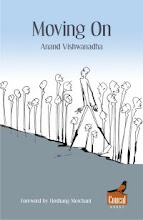
- Hello and welcome! I am someone who is passionate about poetry and motorcycling and I read and write a lot (writing, for me has been a calling, a release and a career). My debut collection of English poems, "Moving On" was published by Coucal Books in December 2009. It can be ordered here My second poetry collection, Ink Dries can be ordered here Leave a comment or do write to me at ahighwayman(at)gmail(dot)com.
Take A Look See
-
-
-
Meet Annie the author10 years ago
-
Poems online5 years ago
-
-
-
-
When to have THE TALK with the kids1 year ago
-
An Analysis of Trump9 years ago
-
-
-
Where journeys end9 months ago
-
-
-
-
-
Indian in Space: A phony Socialist trick14 years ago
-
Recipe – Easy Apple Halwa5 years ago


