Hands clenched into fists
around the rear-view mirrors' stands
in my front, the little man rides,
bottom itching on the petrol tank;
at watch, eyes permanently peeled
behind me - pillion sitting -
the bigger little man watches
our road changing, from straight asphalt
into a snaking river of gravel red, flowing
through a sea of motorcycle dwarfing grasses
flowering yellows, purples and russets,
and when just green, like none on any lawn seen.
Monday, October 19, 2009


Deepavali Memories
It’s the Monday after, as I write this.
My street and those all around my place are full of the remains of two days of relatively subdued Deepavali celebrations – with the remnants of the so called “Lakshmi”, “Double Sound” and “Lanka” crackers the most visible, littered like grounded confetti…
And then there are the Deepams, perched on the boundary walls and besides main gates. Some look almost unlit (though there’s the black eye of a burnt wick staring back at you), evidently put out by the cold winds that blow this time of the year; others are well and truly spent, burnt through and through, right to the end of the wick and the last drop of oil – and in burning adding the light of yet another Deepams to the festival of lights – Deepavali.
Light is central to my own memories of Deepavali, my earliest recollections of Deepavali being the recital of “Dubbu Dubbu Deepavali, Malli Vochhey Naagulachavithi”, when I was a little man, with my left hand clutching onto my grandmother and the right hand holding a papaya leaf, its ends festooned with oil-stained pieces of cloth lit up and flaming with light, like so many Deepams.
There is no specific meaning (superficial or deep) that can be ascribed to “Dubbu Dubbu Deepavali, Malli Vochhey Naagulachavithi”, at least none according to Amma (Naagulachavithi however is another festival that comes after Deepavali). When I play amateur anthropologist, I conclude that in all probability its just a ditty meant to safely introduce little men (and women) amongst my community to the Matabulu, Chunchi Buddis and Taara Zuvvalu (Telugu names for home made / locally produced sparklers, fountains and rockets) that would have seemed so dangerous to a little man (or woman).
I don’t know if Dubbu Dubbu is equally important amongst Telugu households these days as it was when I was growing up. Or even if it was that important when I was growing up - though Amma says that my brothers and I partook in this ritual dressed in festival finery till we were 5 years young / old.
Maybe it’s yet another rite of passage for which most of the families these days have no time, or it’s a rite of passage that most have passed by, but come Deepavali, when the Deepams are being lit, the same ditty still echoes in me – “Dubbu Dubbu Deepavali, Malli Vochhey Naagulachavithi”
My street and those all around my place are full of the remains of two days of relatively subdued Deepavali celebrations – with the remnants of the so called “Lakshmi”, “Double Sound” and “Lanka” crackers the most visible, littered like grounded confetti…
And then there are the Deepams, perched on the boundary walls and besides main gates. Some look almost unlit (though there’s the black eye of a burnt wick staring back at you), evidently put out by the cold winds that blow this time of the year; others are well and truly spent, burnt through and through, right to the end of the wick and the last drop of oil – and in burning adding the light of yet another Deepams to the festival of lights – Deepavali.
Light is central to my own memories of Deepavali, my earliest recollections of Deepavali being the recital of “Dubbu Dubbu Deepavali, Malli Vochhey Naagulachavithi”, when I was a little man, with my left hand clutching onto my grandmother and the right hand holding a papaya leaf, its ends festooned with oil-stained pieces of cloth lit up and flaming with light, like so many Deepams.
There is no specific meaning (superficial or deep) that can be ascribed to “Dubbu Dubbu Deepavali, Malli Vochhey Naagulachavithi”, at least none according to Amma (Naagulachavithi however is another festival that comes after Deepavali). When I play amateur anthropologist, I conclude that in all probability its just a ditty meant to safely introduce little men (and women) amongst my community to the Matabulu, Chunchi Buddis and Taara Zuvvalu (Telugu names for home made / locally produced sparklers, fountains and rockets) that would have seemed so dangerous to a little man (or woman).
I don’t know if Dubbu Dubbu is equally important amongst Telugu households these days as it was when I was growing up. Or even if it was that important when I was growing up - though Amma says that my brothers and I partook in this ritual dressed in festival finery till we were 5 years young / old.
Maybe it’s yet another rite of passage for which most of the families these days have no time, or it’s a rite of passage that most have passed by, but come Deepavali, when the Deepams are being lit, the same ditty still echoes in me – “Dubbu Dubbu Deepavali, Malli Vochhey Naagulachavithi”
Saturday, October 17, 2009
Deadline Drass
Draas is the last major speck on the map before the mighty Zozi La and the spectacular run into the vale of Kashmir, through honeymoonsy, touristy and picturesque Sonamarg. Draas is also the world's second most cold inhabited place, yet another one-road village of Dardis and other nomadic tribes with Henna dyed beards, vacant looks and duplicitous smiles that would put Bollywood villains to shame.
Riding out of Ladakh into Kashmir, my initial plan was just to pass through Draas in time to make it through the Military check post at Meeramarg. I was however, a bit at sea about the deadline to pass Meeramarg. At Manali, I was told I will be allowed through till 8.30, at Leh, 6.30 and finally at Kargil, I was scared sleepless when told that it closes down at 5.00!
Naturally, I was out of my relatively warm hotel bed in Kargil, at the uncivilized hour of 2.00 in the morning and the temperature was of course anything but warm. I get the fully laden Bullet off its main stand, three odd kicks and nothing happens, I put the choke on and kick again and the bike sputters, starts, misses, sputters and then bursts into its reassuring song.
Kargil's economy is largely dependent on the brave souls who hike from here into Zanskar and God only knows wherever else, and of course the Great Indian Army. And as with most frontier towns, it’s not a place for early morning somnambulism. It was this or the intense cold, but either way I did not have to contend with man's best friend (great shaggy creatures with fangs a shade more Yellow than mine) chasing me as I rode around in circles before finding the road to Draas.
I had heard a lot about this road. It twists and turns with the LOC and there are signboards all along the road, dryly announcing, "Beware, you are under enemy observation". Moreover, since our well-meaning neighbor watches down from behind strategically placed guns, there are no lights anywhere.
The cold was growing every minute and I was not using my gloves, considering that the blasted things were impeding clutching and braking. And I was in thin canvas boots, with just a simple set of woolen socks underneath, the Gum Boots I had picked up at Manali bungeed down, as I wasn’t expecting any water-crossings.
5 minutes out of Kargil, I was frozen to the bone and cursing away to glory, my neck numb and my legs hugging the bike for whatever warmth its petrol-fired heart could gift me.
Usually, I would have just hunkered down and belted away, getting to my destination faster, but that was impossible here, with the narrow road twisting and turning, the stars for most part blocked out by the dark brooding ridges all around and my headlight’s glimmer just a bit more than that of a guttering candle.
There was no traffic on the road that I could tail and when I would slow down to pass through the military camps, all I could usually see was a milestone indicating that I am on the right road, or when a bit more luckier, some friendly sentry’s hand going up in the instinctive greeting only a biker gets.
Then, it happens; I take a curve too fast, the road straightens on to a bridge, I hit a speed breaker I can’t see, the bike’s angle and the heavily laden carrier don’t help and its really touch and go as I head towards the stanchions and the dark waters below.
I have never been good at reconstructing such scrapes on the road, but it was either my momentum or my riding instinct that saved me. I had cut across the bridge diagonally, finally braking inches from the end of the road.
Whew!
Before I can get off the bike, a torch shines into my face. It’s a brave Jawan of the Great Indian Army, firm and solicitous at the same time, wanting to know who I am, why I am out at this time of the morning and where I am headed. My tone is equally firm and polite as he checks my papers, jots down my details and then waves me on, with a smile that only the sane can bestow on the cerebrally challenged.
For now I am just intent on hanging on and counting the milestones till I get to Draas. There is no way I could have sped on this stretch; the road was just a bit more than a patch of gravel with water flowing over it.
The last 15 odd kms to Draas are still frozen in my being, my hands were bereft of feeling, forcing me to put them one by one on the cylinder head, wait till the engine burnt through the numbness, then ride a bit and then repeat it all over again. Time to time, I would swivel my head to get whatever bearings I could, see the ridges on my right illuminated by big yellow splotches of moving light and wonder grimly if it was the Pakistanis getting ready to shell. And somewhere here, my bike hit reserve.
Finally, the road sloped down and became a street with water flowing through it and I was in Draas before I realized it. I made a beeline for the only street-side eatery that was open; managed to mouth the word “Chhai” and practically thrust my hands into the welcome blue and golden flames of a Kerosene stove.
It was just 4.45 AM, I had met my deadline with Draas, though Meeramarg was still relatively far and I was now out of petrol. I also got to know that there is no petrol bunk in Draas and I may have to go back to Kargil to get it.
But I wasn’t greatly worried, I was just riding through, and the mountain had been kind to me all along, as it is to those who "believe". For now, it was time to let the warmth seep into me, time to savor yet another glass of Tea, besides the road, in yet another one-street outpost…………
Riding out of Ladakh into Kashmir, my initial plan was just to pass through Draas in time to make it through the Military check post at Meeramarg. I was however, a bit at sea about the deadline to pass Meeramarg. At Manali, I was told I will be allowed through till 8.30, at Leh, 6.30 and finally at Kargil, I was scared sleepless when told that it closes down at 5.00!
Naturally, I was out of my relatively warm hotel bed in Kargil, at the uncivilized hour of 2.00 in the morning and the temperature was of course anything but warm. I get the fully laden Bullet off its main stand, three odd kicks and nothing happens, I put the choke on and kick again and the bike sputters, starts, misses, sputters and then bursts into its reassuring song.
Kargil's economy is largely dependent on the brave souls who hike from here into Zanskar and God only knows wherever else, and of course the Great Indian Army. And as with most frontier towns, it’s not a place for early morning somnambulism. It was this or the intense cold, but either way I did not have to contend with man's best friend (great shaggy creatures with fangs a shade more Yellow than mine) chasing me as I rode around in circles before finding the road to Draas.
I had heard a lot about this road. It twists and turns with the LOC and there are signboards all along the road, dryly announcing, "Beware, you are under enemy observation". Moreover, since our well-meaning neighbor watches down from behind strategically placed guns, there are no lights anywhere.
The cold was growing every minute and I was not using my gloves, considering that the blasted things were impeding clutching and braking. And I was in thin canvas boots, with just a simple set of woolen socks underneath, the Gum Boots I had picked up at Manali bungeed down, as I wasn’t expecting any water-crossings.
5 minutes out of Kargil, I was frozen to the bone and cursing away to glory, my neck numb and my legs hugging the bike for whatever warmth its petrol-fired heart could gift me.
Usually, I would have just hunkered down and belted away, getting to my destination faster, but that was impossible here, with the narrow road twisting and turning, the stars for most part blocked out by the dark brooding ridges all around and my headlight’s glimmer just a bit more than that of a guttering candle.
There was no traffic on the road that I could tail and when I would slow down to pass through the military camps, all I could usually see was a milestone indicating that I am on the right road, or when a bit more luckier, some friendly sentry’s hand going up in the instinctive greeting only a biker gets.
Then, it happens; I take a curve too fast, the road straightens on to a bridge, I hit a speed breaker I can’t see, the bike’s angle and the heavily laden carrier don’t help and its really touch and go as I head towards the stanchions and the dark waters below.
I have never been good at reconstructing such scrapes on the road, but it was either my momentum or my riding instinct that saved me. I had cut across the bridge diagonally, finally braking inches from the end of the road.
Whew!
Before I can get off the bike, a torch shines into my face. It’s a brave Jawan of the Great Indian Army, firm and solicitous at the same time, wanting to know who I am, why I am out at this time of the morning and where I am headed. My tone is equally firm and polite as he checks my papers, jots down my details and then waves me on, with a smile that only the sane can bestow on the cerebrally challenged.
For now I am just intent on hanging on and counting the milestones till I get to Draas. There is no way I could have sped on this stretch; the road was just a bit more than a patch of gravel with water flowing over it.
The last 15 odd kms to Draas are still frozen in my being, my hands were bereft of feeling, forcing me to put them one by one on the cylinder head, wait till the engine burnt through the numbness, then ride a bit and then repeat it all over again. Time to time, I would swivel my head to get whatever bearings I could, see the ridges on my right illuminated by big yellow splotches of moving light and wonder grimly if it was the Pakistanis getting ready to shell. And somewhere here, my bike hit reserve.
Finally, the road sloped down and became a street with water flowing through it and I was in Draas before I realized it. I made a beeline for the only street-side eatery that was open; managed to mouth the word “Chhai” and practically thrust my hands into the welcome blue and golden flames of a Kerosene stove.
It was just 4.45 AM, I had met my deadline with Draas, though Meeramarg was still relatively far and I was now out of petrol. I also got to know that there is no petrol bunk in Draas and I may have to go back to Kargil to get it.
But I wasn’t greatly worried, I was just riding through, and the mountain had been kind to me all along, as it is to those who "believe". For now, it was time to let the warmth seep into me, time to savor yet another glass of Tea, besides the road, in yet another one-street outpost…………
The Motorcyclist

At its zenith, a full and bodacious moon whitened the heavens above as a lone Bullet snaked up through the Mothugudem Ghats. The night was typical of the summer, tropical interiors and the forests of the Deccan, the air warm and thinned out for most part - with pockets that smelled of swamp, rice-fields and water-holes - redolent with the heat of the day already 6 hours past.
Sitting straight and alert, his Denim Jacket and Denim pants comfortably draped over his road-limbered body, the motorcyclist looked as if he could ride till the proverbial end of the world, just on and on.
The night had always been his element and the remoteness anyway meant that there was not much incentive to stop for anything apart from a hurried smoke or an urgent leak behind the bushes.
His scalp itching under the battered, dust covered helmet, he luxuriated in the feel of the moving night air balmily caressing his face - through the open visor - the hair of his beard and moustache fluttering with every turn as he ascended up on a road he knew not much about.
His thoughts went back 200 kms and 6 hours, to Junglepally and the small Forest Check Post where he had decided to turn off from N.H. 211, after 3 hours of riding non-stop - at speeds averaging 100kmph - bored by the monotony and thirsting for a mystery road. The village wit who bummed a smoke from him wanted to know why he was headed on a road that "did not go anywhere". Usually, he would have laughed it off as something typical of the inanities of the road and forgotten it forever.
But tonight, somehow that question was fluttering and flying in his head, like a tetchy bat in a dark cavern; awaking another thousand questions he had always assumed to be permanently asleep.
Am I truly yet another average Joe?
Is this riding - usually with absolutely no real destination in mind - truly indicative of my aimlessness in life?
Or is it my way of giving the finger to a world that is all about stereotypes, my way of proclaiming my independence?
Even as one unwelcome question led to yet another unwelcome question in the depth of his being, he suddenly seemed to have ridden into a spellbinding world of luminescence, suddenly it seemed it was day.
The Ghat stretch ended and to his left, for as far as his trail-weary and crow-feeted eyes could see, there were the rolling, limpidly lit expanses of the Sabari's highland catchment area. Almost out of no volition, as if guided by a power and reason without, he eased off on the throttle, geared down to neutral and then braked to a smooth stop at the very edge of the drop. Stretched out below him and beneath the Bullet's front wheel, the reservoir glinted at its middle like it was of beaten silver, the troughs of the small ripples dribbling with a glint like fool's gold and the gentle waves coursing landwards liquidly like mercury.
Almost as suddenly, as if born out a Cherub's breath or a Nightjar's fluttering wings, a breeze started blowing, carrying the cold air that sat on the reservoir's waters, upwards to his sweat-soaked body and still-hot Bullet, cooling things only the way something truly wild can.
With rapidity reminiscent of the changing of weather on a high-altitude pass, the breeze strengthened into a gale and clouds started scudding across the till-now empty skies, their dark shadows flitting across the reservoir and dappling the waters. The air no longer just smelled of the wilds and the still waters, overlaid on everything else now was the fragrant smell of a summer-baked earth soaking in the first drops of rain - somewhere just around him, even though beyond his immediate sight - satiating his entire being through his nostrils.
Outwardly looking the same, the motorcyclist was now at inner peace. The reverie was now broken and though he still couldn't remember those thousand questions; he realized that he finally had the answer to why he was the way he was. Mentally congratulating his instinct - something that had led him to packing the raincoat and plastic sheets - he wheeled the Bullet below a massive Neem tree with a Choupal that could be a welcome bed for the night.
Bike parked, he again walked to the rim of the reservoir, lit up a smoke and gazed across what was uncontestedly his own kingdom. His and his alone, at least for that one moment when the first drops of rain would raise a toast to the mystique of a Full Moon shining on deep waters in wilds criss-crossed by mystery roads.
He was already thinking forward to riding through the rain-blessed forests on the morrow as the first fat, bodaciously big raindrop hit him in the face; a face split in a grin that was sheer happiness.
Saturday, July 4, 2009
Srisailam
Shiva.
The God with the third eye, who destroys and then creates.
The dusky, ash-covered lord of the celestial, snow-covered and craggy heights of Kailash.
The most feared (and yet, limpid eyed) of the Hindu triumvirate.
And so on, and so forth.
But all these descriptions of him are middle-path acknowledgements, all these are the ways he is deified in the politically correct form within the Hindu pantheon. And also, how he is discussed in the drawing rooms of the prim and proper.
For those who understand and accept creation and life in its very basic form, be it the ash-smeared bhakta or the bedraggled, "who cares if I bathe or not", matty haired, chillum smoking Babas and Sadhus, he's basically a piece of stone.
A cylindrically perfect piece of stone, a Phallic symbol if you will, a symbol of male virility thrusting into and limited by female acceptance, a symbol of lively zest and of course, the pure, raw power that creates and multiplies, come what may.
I am talking of the sacred stone, the Lingam. When you go to most temples, Shiva, the Shiva of yore, the original rebel God of the Hindu pantheon, does seem tamed at last, bound by temple rituals, seperated from his (equally bound) devotees, yet another God in yet another temple.
Unless the temple in question happens to be in thick forests or lofty heights. Unless, the Lingam in question happens to be a Jyotirlingam, a manifestation of Shiva himself. As it is in Srisailam.
Around 8 hours from Hyderabad by bus, the last three of them through the fabled Srisailam Tiger Reserve [including a heart popping, edge of the seat (assuming you are awake or bus-sick) descent and ascent of the bridged gorge on the River Krishna] is Andhra Pradesh's only Jyotirlingam. And one of the twelve in India. Located upriver of the massive Srisailam Hydel project, the temple town seems to hark back to the very days of Shiva. Surrounded as it is by green hills and deep waters, both as silent and mysterious as Shiva himself and almost as wild. And fittingly, the temple town doesn't have too many of the consumerist or market-driven bric-a-brac; making do with a couple of choultries and the ubiquitous souvenir shops.
The actual temple complex is a fort that you can enter by buying a ticket that costs all of Rs.2. You do need to queue up with all those who can afford that Rs. 2. But the darshan is quick and very, very simple when compared to that at places like Tirumala. Also, if you there when the Nalla Malla hills are could-swathed or when its winter, the cold flags seem burning hot to your bare feet.
For all purposes reminiscent of how it would be if you were a pilgrim going up a glacier on the icy heights of Mount Kailash. Almost.
If you are lucky enough to be the type woken up early by faith or if you had planned your darshan right, you can be party to an awesome occassion. The priests and the temple musicians wake up the Lord in the early hours of the morning, around 5.00 to be exact. To the strains of Nadaswarams, drums and Vedic chants that seem to reverberate from each and every stone in the temple.
This is a once in a lifetime experience, for the profoundly devout, the fearfully pious and the "culturally here" agnostic. Give your imagination a bit of rope and you will feel that you are wee bit closer to the cosmic power source, the vitality that makes you alive, the lifeblood that throbs through you, the positive charge in you that searches for, unites with and then procreates along with the negative.
You feel a bit closer to understanding and accepting the basic meaning of Shiva.
The actual Darshan is no less magical. You are at one of India's 12 Jyotirlingams in a day and age when pilgrimages are no longer backbreaking affairs. Yet, immaterial of the crowds or the time of the day, there are no temple attendees shooing you away when you are in the Sanctum.
Allow me to digress here, if you will. I have always wondered about the ritualistic, even repetititve element in Hinduism, specifically when it comes to temples. People (most of them at least), queue up for darshan, silently, even meekly like they are cattle. They move along again, for the most part, in silent order, as if getting herded along. And then, once they are in the Sanctum, all of a sudden religious fervour grabs them! As if the charmed ghosts of all the saint-poets and mendicant-singers associated with the deity in question have collectively entered into their beings! So you witness a hitherto meek person suddenly transformed into a devotee in a trance, enthralled in "Darshan". Making you wonder at the almost choreographed nature of the devotion, the stagey prostations, off-key chants and what not's.
Well, you will see none of this in Srisailam. Because, here a very important, nay integral part of Darshan is touching the Lingam with both hands! While the priest on duty recites hymns and blessings for you. Which means here you get a one-on-one that makes even the most irrational realize the needlessness of being stagey.
Temple visit done, after you have gone around figuring out which entrance to the temple was built by Shivaji and tried to understand what the carvings on the fort walls mean, you could also put your feet to work. Real work if I may say so; by going down to Patalganga Ghat on irregular steps where many Sadhus sit doing what Sadhus do best. Modern day Patalganga Ghat is nothing but the edge of the man-made reservoir that stretches in front of you and you can even see the huge dam from here. Immaterial of the amount of water in the reservoir, you can try and discover how close your heart gets to your mouth when you are in a Coracle on the waters.
If you are a bit more excitement minded than most (and your boatman is amenable) you could also row over to one of the islands that dot the reservoir and contemplate a trek through what looks impenetrable jungle. The rare chance of coming face to face with one of the tigers of Srisailam shouldn't scare you.
After all, Shiva does reside in you too, does He not?
P.S - This is the first travelogue (for want of a better word) that I had written; after my very first visit to Srisailam, way back in 1999 or so. Srisailam has changed a bit since then, and my own understanding of Shiva has changed a lot since then :-)
The God with the third eye, who destroys and then creates.
The dusky, ash-covered lord of the celestial, snow-covered and craggy heights of Kailash.
The most feared (and yet, limpid eyed) of the Hindu triumvirate.
And so on, and so forth.
But all these descriptions of him are middle-path acknowledgements, all these are the ways he is deified in the politically correct form within the Hindu pantheon. And also, how he is discussed in the drawing rooms of the prim and proper.
For those who understand and accept creation and life in its very basic form, be it the ash-smeared bhakta or the bedraggled, "who cares if I bathe or not", matty haired, chillum smoking Babas and Sadhus, he's basically a piece of stone.
A cylindrically perfect piece of stone, a Phallic symbol if you will, a symbol of male virility thrusting into and limited by female acceptance, a symbol of lively zest and of course, the pure, raw power that creates and multiplies, come what may.
I am talking of the sacred stone, the Lingam. When you go to most temples, Shiva, the Shiva of yore, the original rebel God of the Hindu pantheon, does seem tamed at last, bound by temple rituals, seperated from his (equally bound) devotees, yet another God in yet another temple.
Unless the temple in question happens to be in thick forests or lofty heights. Unless, the Lingam in question happens to be a Jyotirlingam, a manifestation of Shiva himself. As it is in Srisailam.
Around 8 hours from Hyderabad by bus, the last three of them through the fabled Srisailam Tiger Reserve [including a heart popping, edge of the seat (assuming you are awake or bus-sick) descent and ascent of the bridged gorge on the River Krishna] is Andhra Pradesh's only Jyotirlingam. And one of the twelve in India. Located upriver of the massive Srisailam Hydel project, the temple town seems to hark back to the very days of Shiva. Surrounded as it is by green hills and deep waters, both as silent and mysterious as Shiva himself and almost as wild. And fittingly, the temple town doesn't have too many of the consumerist or market-driven bric-a-brac; making do with a couple of choultries and the ubiquitous souvenir shops.
The actual temple complex is a fort that you can enter by buying a ticket that costs all of Rs.2. You do need to queue up with all those who can afford that Rs. 2. But the darshan is quick and very, very simple when compared to that at places like Tirumala. Also, if you there when the Nalla Malla hills are could-swathed or when its winter, the cold flags seem burning hot to your bare feet.
For all purposes reminiscent of how it would be if you were a pilgrim going up a glacier on the icy heights of Mount Kailash. Almost.
If you are lucky enough to be the type woken up early by faith or if you had planned your darshan right, you can be party to an awesome occassion. The priests and the temple musicians wake up the Lord in the early hours of the morning, around 5.00 to be exact. To the strains of Nadaswarams, drums and Vedic chants that seem to reverberate from each and every stone in the temple.
This is a once in a lifetime experience, for the profoundly devout, the fearfully pious and the "culturally here" agnostic. Give your imagination a bit of rope and you will feel that you are wee bit closer to the cosmic power source, the vitality that makes you alive, the lifeblood that throbs through you, the positive charge in you that searches for, unites with and then procreates along with the negative.
You feel a bit closer to understanding and accepting the basic meaning of Shiva.
The actual Darshan is no less magical. You are at one of India's 12 Jyotirlingams in a day and age when pilgrimages are no longer backbreaking affairs. Yet, immaterial of the crowds or the time of the day, there are no temple attendees shooing you away when you are in the Sanctum.
Allow me to digress here, if you will. I have always wondered about the ritualistic, even repetititve element in Hinduism, specifically when it comes to temples. People (most of them at least), queue up for darshan, silently, even meekly like they are cattle. They move along again, for the most part, in silent order, as if getting herded along. And then, once they are in the Sanctum, all of a sudden religious fervour grabs them! As if the charmed ghosts of all the saint-poets and mendicant-singers associated with the deity in question have collectively entered into their beings! So you witness a hitherto meek person suddenly transformed into a devotee in a trance, enthralled in "Darshan". Making you wonder at the almost choreographed nature of the devotion, the stagey prostations, off-key chants and what not's.
Well, you will see none of this in Srisailam. Because, here a very important, nay integral part of Darshan is touching the Lingam with both hands! While the priest on duty recites hymns and blessings for you. Which means here you get a one-on-one that makes even the most irrational realize the needlessness of being stagey.
Temple visit done, after you have gone around figuring out which entrance to the temple was built by Shivaji and tried to understand what the carvings on the fort walls mean, you could also put your feet to work. Real work if I may say so; by going down to Patalganga Ghat on irregular steps where many Sadhus sit doing what Sadhus do best. Modern day Patalganga Ghat is nothing but the edge of the man-made reservoir that stretches in front of you and you can even see the huge dam from here. Immaterial of the amount of water in the reservoir, you can try and discover how close your heart gets to your mouth when you are in a Coracle on the waters.
If you are a bit more excitement minded than most (and your boatman is amenable) you could also row over to one of the islands that dot the reservoir and contemplate a trek through what looks impenetrable jungle. The rare chance of coming face to face with one of the tigers of Srisailam shouldn't scare you.
After all, Shiva does reside in you too, does He not?
P.S - This is the first travelogue (for want of a better word) that I had written; after my very first visit to Srisailam, way back in 1999 or so. Srisailam has changed a bit since then, and my own understanding of Shiva has changed a lot since then :-)
Subscribe to:
Posts (Atom)
About Me
- Anand Vishwanadha
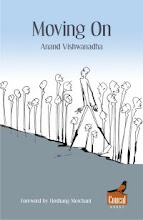
- Hello and welcome! I am someone who is passionate about poetry and motorcycling and I read and write a lot (writing, for me has been a calling, a release and a career). My debut collection of English poems, "Moving On" was published by Coucal Books in December 2009. It can be ordered here My second poetry collection, Ink Dries can be ordered here Leave a comment or do write to me at ahighwayman(at)gmail(dot)com.
Take A Look See
-
-
-
Meet Annie the author10 years ago
-
Poems online5 years ago
-
-
-
-
When to have THE TALK with the kids1 year ago
-
An Analysis of Trump9 years ago
-
-
-
Where journeys end9 months ago
-
-
-
-
-
Indian in Space: A phony Socialist trick14 years ago
-
Recipe – Easy Apple Halwa5 years ago


